Beyond the Blueprint: Why Your LOD Choice Could Make or Break Your Industrial Project
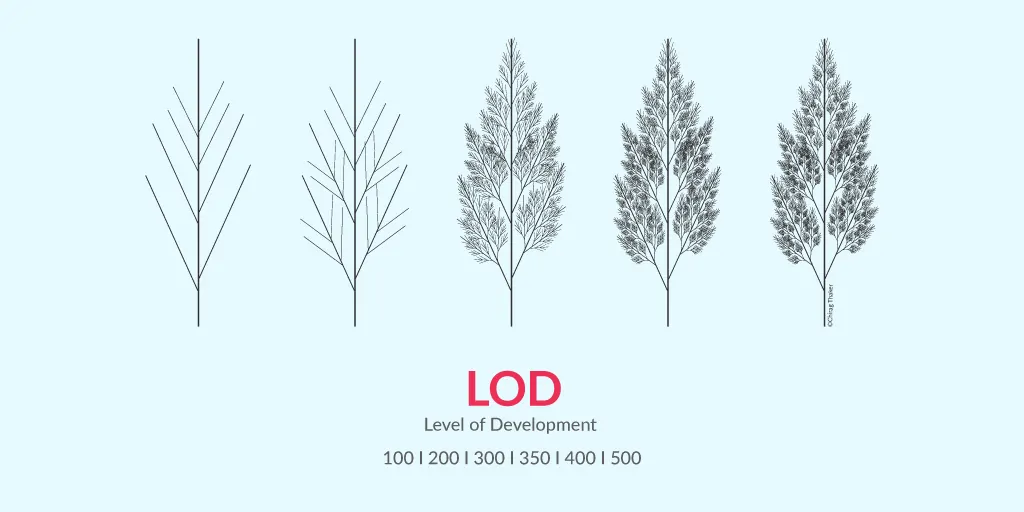
In the world of Building Information Modeling (BIM), there is a persistent and dangerous myth: that more detail is always better. For many industrial project stakeholders, the instinct is to push for the highest “Level of Development” (LOD) possible. They assume that a higher number automatically equates to a more successful project, a more accurate model, and fewer headaches on site.
However, “over-modeling”—requesting a level of development that exceeds the project’s actual operational needs—is one of the fastest ways to drain a capital budget and stifle a schedule. From my perspective as a strategist, a model is not just a 3D drawing; it is a contractual communication tool. Choosing an LOD that is too high for your requirements creates unnecessary overhead, while choosing one that is too low for fabrication can lead to catastrophic site errors where components manufactured off-site simply do not fit field conditions.
The central challenge is not about reaching the “highest” level; it is about choosing the right level for the specific phase of the asset’s life. Understanding the nuance between these standards is the difference between a model that functions as a high-utility asset and one that becomes a massive financial liability.
Takeaway 1: Development vs. Detail — The Difference Between Pixels and Trust
It is a common mistake to use the terms “Level of Detail” and “Level of Development” interchangeably, but they represent two distinct concepts. Level of Detail refers to how much graphical information is included in a model element — essentially, how many “pixels” or visual features are present.
Level of Development, however, is a measure of reliability. It is a reference tool intended to improve the quality of communication by defining the degree to which a project team can rely on the information provided by an element. An element might look highly detailed (high Level of Detail) but still be based on approximate locations or generic sizes (low Level of Development).
Level of Development is the degree to which the element’s geometry has been thought through — the degree to which project team members may rely on the information when using the model.
In a contractual sense, LOD tells the rest of the project team exactly what they are allowed to do with your model. If an element is at LOD 200, a stakeholder knows the location is approximate; if it is at LOD 350, they know they can use it for construction-level coordination and clash detection.
Takeaway 2: The Build vs. Maintain Divide (The LOD 400 vs. 500 Reality)
In industrial fabrication, the choice between LOD 400 and LOD 500 is dictated by the model’s ultimate purpose. While they are often compared, they serve fundamentally different phases of the asset lifecycle.
- LOD 400 (As-Designed): Designed for fabrication, assembly, and installation. It contains detail sufficient for shop drawings and off-site manufacturing. It is accurate enough for cutting, welding, and CNC automation workflows.
- LOD 500 (As-Constructed): Designed for facility management and life-cycle operations. Unlike the previous levels, LOD 500 represents the “as-built” condition — the structure as it actually exists on the site after construction is finished, verified through field observation.
LOD 400 is for building, LOD 500 is for operating the built asset.
The LOD updates clarify that LODs 100 through 400 represent “as-designed” elements. LOD 500 is a different animal entirely, representing “existing” conditions.
Takeaway 3: LOD 350 — The “Goldilocks Zone” of Coordination
LOD 350 was created to bridge the gap between LOD 300 (Design Intent) and LOD 400 (Fabrication). While LOD 300 allows for the measurement of size and shape, it often lacks the “actual” dimensions required for trade-to-trade coordination.
The critical distinction here is that LOD 350 usually requires craft knowledge. This is why Architects of Record (AORs) typically stop at LOD 300; they understand the design intent, but may lack the specialized trade experience to model exactly how a system interfaces with adjacent elements. LOD 350 is where the strategist or VDC lead bridges the gap to ensure the model is “construction-ready.”
LOD 350 focuses on “interfaces with adjacent or dependent Model Elements,” making it the essential level for clash detection. By modeling specific inclusions, teams avoid the massive cost of “field-cutting” when systems don’t line up. According to BIMForum standards, LOD 350 must include:
- Actual dimensions required for construction-level coordination (as opposed to nominal design dimensions).
- Rough opening dimensions for all penetrations to ensure fit.
- Support and connection elements such as expansion joints, dowels, embeds, and lintels.
- Chamfers and void boxes necessary for accurate structural placement and coordination.
Takeaway 4: LOD 500 is a “Reality Check,” Not a Higher Resolution
It is a common misconception that LOD 500 is simply “more detailed” than LOD 400. In reality, LOD 500 does not indicate increased geometric complexity. Instead, it indicates that the geometry has been verified through field observation.
This verification is often achieved through 3D laser scanning to ensure the model reflects the exact “as-constructed” installation. Because LOD 500 requires a specific level of field verification, I always recommend that project teams utilize the USIBD’s Level of Accuracy (LOA) Specification to define and specify exactly how accurate that field data must be.
Beyond the physical geometry, LOD 500 serves as the “fuel” for a Digital Twin. It includes non-geometric data essential for the next 30 years of the plant’s life, such as:
- Manufacturer details and serial numbers.
- Maintenance schedules and performance parameters.
- Operations and Maintenance (O&M) documentation.
Takeaway 5: The Financial Danger of Over-Modeling
As a strategist, I have to be blunt: requesting a higher LOD than you actually need is a fiscal liability. Modeling to LOD 500 is substantially more expensive than LOD 400 because it necessitates on-site verification, 3D laser scanning, and the manual input of maintenance data for every asset.
If your project does not require lifecycle asset management, requesting LOD 500 is essentially paying for a 3D laser scan that you will never use. For most industrial contractors, LOD 400 provides the necessary accuracy for cutting and assembly at a much more competitive price point. Follow this simple logic to protect your budget: if you need to build it, aim for LOD 400. If you need to maintain it for decades to follow, only then should you invest in the verification costs of LOD 500.
A Quick Reference Guide: Industrial Scenarios
The following table illustrates how to apply these standards to common industrial fabrication needs.
| Scenario | Recommended LOD | The “Why” |
|---|---|---|
| Pipe Spool Fabrication | LOD 400 | Exact geometry and connections are required for workshop fabrication and welding. |
| Commissioning a New Plant | LOD 500 | Owners require verified, as-built data for long-term maintenance and asset tracking. |
| Modular Skid Design | LOD 400 | Modules must be fabricated off-site with extreme precision to ensure they fit upon delivery. |
| Lifecycle Asset Management | LOD 500 | Facility teams need real-world data, serial numbers, and O&M parameters for every asset. |
Conclusion: The Future of the Digital Asset
Adhering to strict LOD standards ensures that industrial projects remain efficient, predictable, and free from the costs of unnecessary rework. By progressively moving from LOD 300 for design coordination to LOD 400 for fabrication, and finally to LOD 500 for operations, we ensure that the right information is available — and reliable — at the right time.
As you plan your next project, ask yourself: Is your model built on design intent, or is it ready for the reality of the field and the decades of maintenance to follow?